
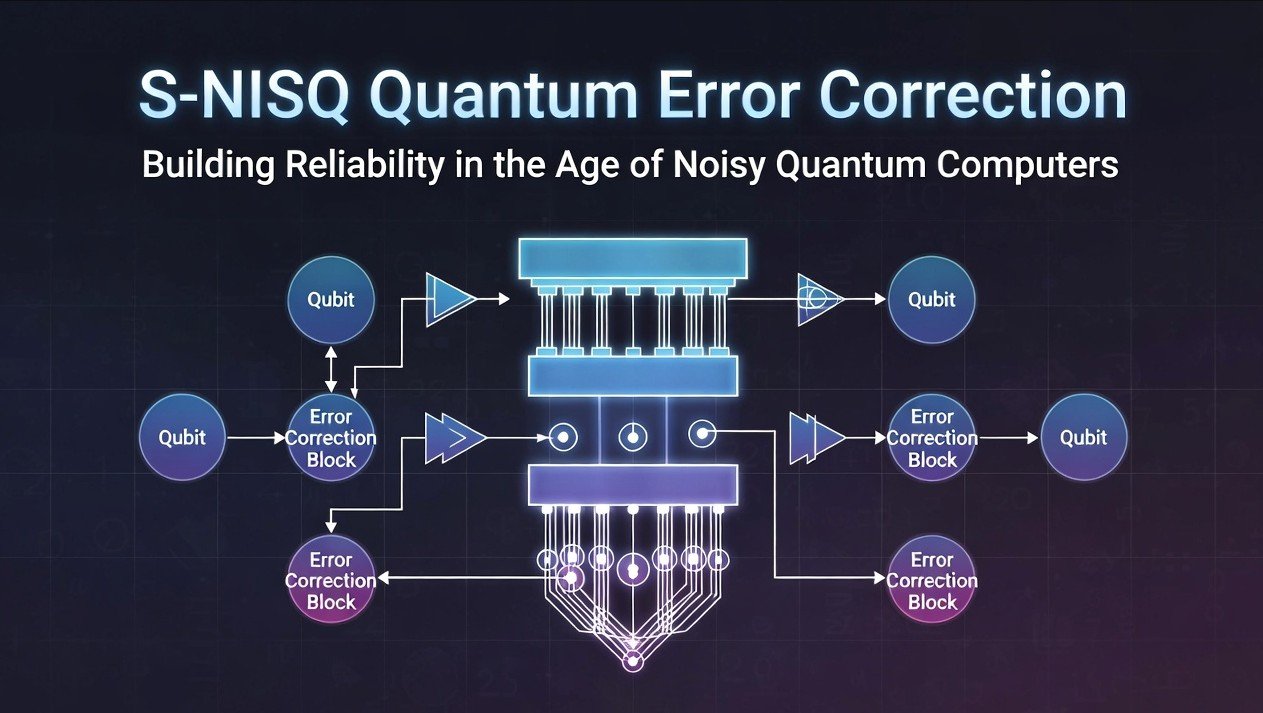
S-NISQ Quantum Error Correction: Building Reliability in the Age of Noisy Quantum Computers
Quantum computing often feels like science fiction becoming real. Scientists promise machines that can solve problems far beyond the reach of classical computers. These include drug discovery, climate modeling, and complex optimization.
Yet there is a problem that every researcher quietly battles: noise. Quantum devices are fragile. Even the smallest disturbance can destroy a quantum state. When that happens, the result of the computation becomes unreliable.
This challenge is why researchers are investing heavily in quantum error correction. However, most classical approaches require thousands of qubits. Current machines simply do not have that capacity.
That gap has led to a new idea called s-nisq quantum error correction. It focuses on improving reliability in today’s noisy hardware without requiring massive resources. Instead of waiting decades for perfect machines, this approach helps us use the imperfect systems we already have.
Understanding the NISQ Era of Quantum Computing
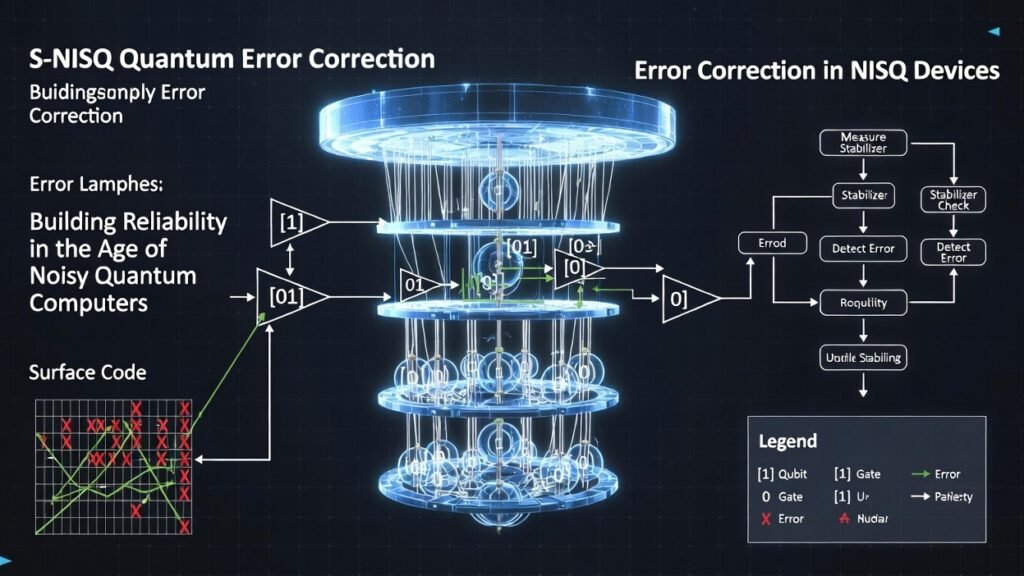
To appreciate s-nisq quantum error correction, we first need to understand the stage of quantum technology we are currently in.
Researchers often describe modern quantum processors as belonging to the NISQ era, which stands for Noisy Intermediate-Scale Quantum computing. These machines are powerful but not yet fully reliable.
Typical characteristics of NISQ devices include:
- Tens to hundreds of qubits
- Limited coherence time
- Imperfect quantum gates
- Noise from the environment
- Restricted connectivity between qubits
Think of NISQ computers like early airplanes. They can fly, but they are not yet safe enough for everyday travel.
Because of these limits, researchers focus on making existing hardware more dependable. This is where s-nisq quantum error correction becomes essential.
Why Quantum Information Is So Fragile
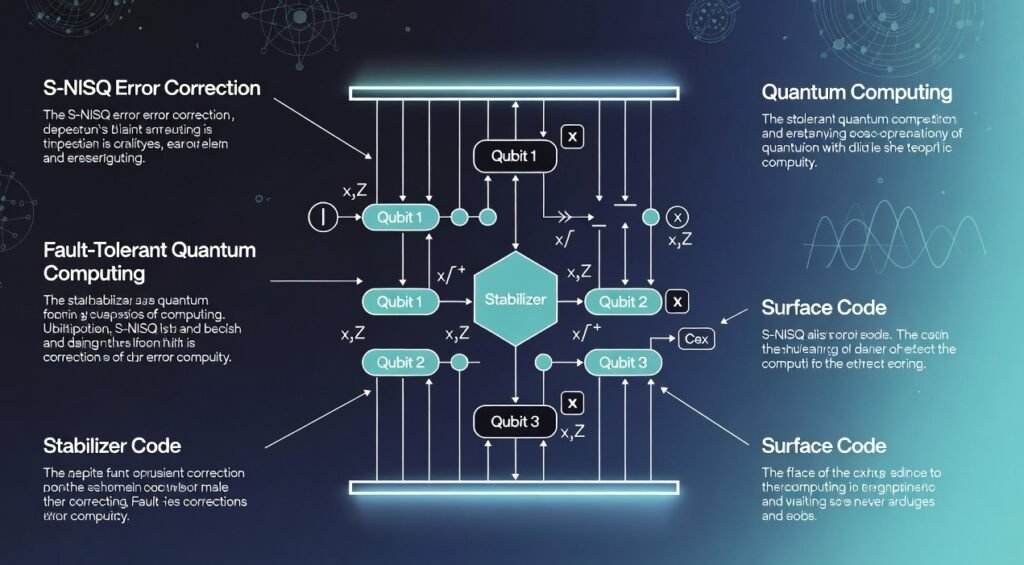
Quantum information behaves very differently from classical data. In a normal computer, a bit is either 0 or 1.
In quantum systems, a qubit can exist in multiple states at once through a property called superposition. Qubits can also interact through entanglement, allowing extremely powerful computations.
However, these advantages come with a downside.
Quantum states are extremely sensitive. Even small disturbances can collapse them. When that happens, the information stored inside the qubit disappears.
Some common sources of errors include:
- Decoherence
- Gate imperfections
- Measurement noise
- Qubit cross-talk
These issues make reliable quantum computing extremely difficult.
This reality explains why researchers see s-nisq quantum error correction as a practical path forward.
Types of Noise That Affect Quantum Computers
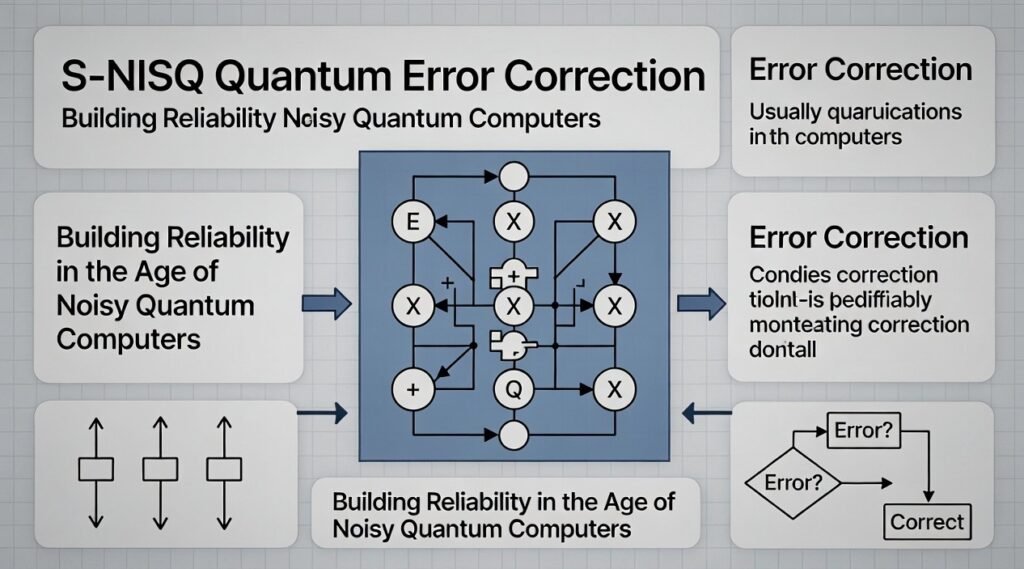
Quantum hardware faces several kinds of noise. Each one introduces uncertainty into the computation.
Below is a simple overview.
| Noise Type | Description | Impact on Computation |
| Decoherence | Qubits interact with the environment | Loss of quantum state |
| Gate Errors | Imperfect quantum operations | Incorrect logic operations |
| Measurement Errors | Detectors misread qubit states | Wrong output values |
| Crosstalk | Nearby qubits influence each other | Unexpected disturbances |
These problems accumulate during long circuits. The deeper the quantum algorithm, the higher the chance of failure.
That is why improving reliability is so important for near-term quantum systems.
Why Classical Error Correction Cannot Be Directly Used
In classical computing, error correction is simple. If data gets corrupted, the system can copy the information and compare results.
Quantum systems cannot do this.
A fundamental rule called the no-cloning theorem states that quantum states cannot be copied perfectly. This restriction prevents straightforward backup methods.
Because of this rule, quantum error correction must use a different strategy. Instead of copying data, information is encoded across multiple qubits.
Traditional quantum codes include:
- Surface codes
- Shor codes
- Color codes
While powerful, these methods require large numbers of qubits.
For example, protecting one logical qubit may require thousands of physical qubits. That scale is far beyond today’s hardware.
This limitation is exactly why s-nisq quantum error correction is gaining attention.
The Concept Behind S-NISQ Quantum Error Correction
At its core, s-nisq quantum error correction is about practicality.
Instead of aiming for perfect fault tolerance immediately, researchers focus on incremental improvements that work within current hardware limits.
The idea combines several strategies:
- Lightweight encoding schemes
- Noise-aware algorithm design
- Hybrid classical–quantum correction
- Error mitigation techniques
This approach allows quantum devices to perform longer and more reliable computations without massive overhead.
In simple terms, it helps noisy machines behave a little more like stable ones.
Key Characteristics of S-NISQ Quantum Error Correction
Several principles define this emerging framework.
1. Resource Efficiency
Traditional quantum error correction consumes large numbers of qubits. Near-term machines simply cannot afford that cost.
S-nisq quantum error correction focuses on using small overhead while still improving reliability.
Instead of thousands of qubits, a scheme may require only a handful of extra qubits.
This balance makes experiments feasible on real devices.
2. Noise-Aware System Design
Every quantum processor behaves differently.
For example:
- Superconducting qubits suffer from dephasing
- Trapped ions may experience laser instability
- Photonic systems lose photons during transmission
Rather than ignoring these differences, s-nisq quantum error correction adapts correction strategies to each platform.
This targeted approach dramatically improves efficiency.
3. Hybrid Classical–Quantum Processing
Modern quantum systems rarely work alone.
They rely heavily on classical computers for support.
In many s-nisq quantum error correction methods, classical processors perform tasks such as:
- Analyzing error patterns
- Adjusting quantum circuits
- Estimating noise behavior
- Correcting measurement results
This partnership creates a powerful hybrid computing system.
4. Flexible Encoding Structures
Traditional error correction relies on strict mathematical codes.
But NISQ hardware has limited connectivity and restricted circuit depth.
To overcome this, s-nisq quantum error correction often uses flexible encoding structures.
Examples include:
- Repetition codes
- Small surface-code patches
- Bosonic encoding schemes
These lighter methods allow quantum systems to gain partial protection without overwhelming hardware resources.
Core Strategies Used in S-NISQ Quantum Error Correction
Researchers are experimenting with many techniques to improve reliability.
Some focus on preventing errors. Others aim to cancel noise after it occurs.
Let’s explore the most important strategies.
Error Mitigation Instead of Full Correction
One clever approach is error mitigation.
Instead of fixing every error, the system reduces the effect of noise on the final result.
This idea plays a central role in s-nisq quantum error correction.
Common mitigation techniques include:
- Zero-noise extrapolation
- Probabilistic error cancellation
- Measurement correction
- Noise-aware circuit design
These strategies do not require large numbers of qubits.
Instead, they rely on smart analysis of noisy results.
This makes them extremely useful for near-term hardware.
Lightweight Encoding With Repetition Codes
A simple example of encoding is the repetition code.
It protects information by storing it across multiple qubits.
Below is a basic illustration.
| Logical State | Encoded Qubit State |
| 0 | 000 |
| 1 | 111 |
If one qubit flips due to noise, the system can detect the error using majority voting.
Although repetition codes cannot fix all error types, they provide an easy way to experiment with s-nisq quantum error correction on small quantum devices.
Early Surface Code Experiments
Surface codes are among the most promising error correction methods for large-scale quantum computing.
However, they normally require large grids of qubits.
Researchers have begun implementing small surface-code patches on NISQ hardware.
These experiments demonstrate:
- Real-time error detection
- Continuous syndrome measurements
- Early forms of logical qubits
Such work shows how s-nisq quantum error correction can gradually lead toward full fault tolerance.
Bullet Summary: Why This Approach Matters
Here are some quick reasons why this research direction is so important.
- It makes current quantum devices more useful
- It reduces the need for thousands of qubits
- It improves the reliability of quantum algorithms
- It accelerates the transition to fault-tolerant quantum computing
- It bridges theory and practical hardware
Without approaches like s-nisq quantum error correction, progress in quantum computing would move much slower.
Zero-Noise Extrapolation: Learning From Controlled Noise
One clever technique in s-nisq quantum error correction is zero-noise extrapolation. The idea sounds strange at first. Researchers intentionally increase noise during an experiment.
Then they observe how results change as noise grows. Using this data, they estimate what the result would be if the system had zero noise.
The process usually follows three steps:
- Run a circuit normally
- Stretch gate operations to increase noise
- Extrapolate results back to the noise-free limit
This method does not require extra qubits. It works well for small circuits and short computations. That makes it extremely useful in today’s NISQ quantum processors.
Probabilistic Error Cancellation
Another interesting method in s-nisq quantum error correction is probabilistic error cancellation. This strategy relies on building a detailed noise model of the quantum hardware.
Once the system understands how errors occur, it can mathematically cancel them.
The process involves:
- Characterizing the noise of each quantum gate
- Applying inverse operations statistically
- Averaging the outcomes of many circuit runs
While this method can demand significant classical computation, it can improve accuracy without requiring extra qubits. For near-term devices, that trade-off is often worthwhile.
Measurement Error Mitigation
Reading the state of a qubit is not always reliable. Detectors sometimes report the wrong value.
Measurement mitigation techniques correct this issue by analyzing the behavior of the detector itself.
Researchers typically perform calibration tests where known states are measured repeatedly. From this data, they build a measurement error matrix.
The matrix allows the system to estimate the true probability distribution of outcomes.
Within s-nisq quantum error correction, this technique can significantly improve final results without modifying the quantum circuit.
The Growing Role of Machine Learning
Artificial intelligence is becoming a surprising ally in s-nisq quantum error correction.
Quantum noise is complex and unpredictable. Traditional models often struggle to describe it accurately. Machine learning algorithms, however, can analyze large datasets and detect hidden patterns.
Several applications are emerging.
First, noise prediction models analyze device telemetry and forecast error patterns.
Second, adaptive circuit optimization helps modify circuits to reduce accumulated errors.
Third, fast syndrome decoding allows neural networks to interpret error signals quickly.
This combination of quantum computing and machine learning could dramatically accelerate progress in error correction.
Hardware Platforms Exploring These Techniques
Many quantum computing platforms are experimenting with strategies related to s-nisq quantum error correction.
Each technology has unique strengths and challenges.
Superconducting Quantum Processors
Superconducting qubits are used by many major research labs and technology companies.
These processors operate at extremely low temperatures. Their architecture allows qubits to be arranged in grid structures that support early surface code experiments.
Researchers focus on improving:
- Gate fidelity
- Qubit coherence time
- Real-time error detection
These improvements help test scalable versions of s-nisq quantum error correction.
Trapped-Ion Quantum Computers
Trapped-ion systems use charged atoms held in electromagnetic fields.
They offer several advantages:
- Extremely high gate accuracy
- Long coherence times
- All-to-all qubit connectivity
Because of these properties, trapped-ion devices are excellent platforms for testing new error correction protocols.
Many researchers believe these systems may lead early demonstrations of scalable logical qubits using s-nisq quantum error correction strategies.
Photonic Quantum Systems
Photonic quantum computers encode information in particles of light.
These systems operate at room temperature and integrate well with existing optical communication networks.
However, photons can be lost during transmission. That means loss-tolerant encoding becomes essential.
Many photonic researchers are developing specialized forms of s-nisq quantum error correction that protect against photon loss rather than gate noise.
Real-World Applications That Benefit From Error Resilience
Improving reliability in quantum hardware unlocks meaningful applications.
Even small reductions in error rates can dramatically expand the depth of quantum circuits.
Several industries are watching closely.
Quantum Chemistry
Accurate simulation of molecules is one of the most promising quantum applications.
Better error control allows researchers to simulate chemical reactions, design new materials, and explore potential drug candidates.
Improved s-nisq quantum error correction helps extend simulation time before noise destroys the calculation.
Optimization Problems
Many industries depend on solving difficult optimization challenges.
Examples include:
- Supply chain planning
- Traffic routing
- Financial portfolio balancing
- Energy grid management
Quantum algorithms could explore huge search spaces faster than classical computers. But reliability is essential.
By improving stability, s-nisq quantum error correction makes these algorithms more practical.
Cryptography Research
Quantum computing has major implications for cryptography.
Researchers are studying how quantum algorithms could break certain encryption systems.
At the same time, they are developing post-quantum cryptography that remains secure even against quantum attacks.
Better hardware reliability through s-nisq quantum error correction allows researchers to test these algorithms more effectively.
Quantum Machine Learning
Another emerging field combines quantum circuits with artificial intelligence.
Hybrid algorithms use classical neural networks alongside quantum processors.
However, machine learning circuits can be deep and complex.
Improving stability through s-nisq quantum error correction allows these algorithms to run longer and produce more meaningful results.
Key Challenges Still Facing the Field
Although progress is exciting, many challenges remain.
Complex Noise Behavior
Quantum noise is not always simple. It can be correlated, time-dependent, and influenced by environmental changes.
Modeling these patterns accurately remains difficult.
Without good noise models, some s-nisq quantum error correction techniques lose effectiveness.
Limited Qubit Counts
Even lightweight error correction schemes require extra qubits.
Today’s quantum processors still have limited capacity.
Researchers must constantly balance qubit resources with algorithm complexity.
Measurement Bottlenecks
Error detection often requires repeated measurements.
Unfortunately, measurement itself can introduce new errors or slow down computation.
Designing efficient measurement strategies remains an active area of research in s-nisq quantum error correction.
Classical Processing Overhead
Some mitigation techniques require heavy classical computation.
For example, probabilistic error cancellation can demand large numbers of circuit repetitions.
While classical computers are powerful, integrating them efficiently with quantum processors remains a challenge.
Future Directions for S-NISQ Quantum Error Correction
The future of s-nisq quantum error correction looks promising. Several technological trends are accelerating progress.
First, qubit coherence times are steadily improving. Better hardware naturally reduces baseline error rates.
Second, advanced control electronics allow faster classical feedback loops.
Third, improved decoding algorithms help detect and correct errors more efficiently.
Fourth, modular quantum networking architectures may allow distributed error correction across multiple devices.
Together, these developments could gradually transform NISQ devices into fully fault-tolerant quantum systems.
Why This Approach Is Essential for the Quantum Roadmap
Building a perfect quantum computer will take many years.
If researchers waited for flawless machines before running useful algorithms, progress would stall.
Instead, the community focuses on practical improvements today.
The philosophy behind s-nisq quantum error correction is simple:
- Use existing hardware
- Improve reliability step by step
- Develop scalable techniques for the future
This approach allows scientists to experiment, learn, and innovate while technology continues to mature.
A Practical Turning Point for Quantum Computing
Quantum computing stands at an exciting stage.
Modern devices can perform remarkable calculations, yet they remain noisy and fragile.
By combining error mitigation, lightweight encoding, hardware-aware design, and intelligent classical processing, s-nisq quantum error correction provides a realistic path forward.
Instead of waiting decades for perfect machines, researchers are learning how to work with imperfect ones.
Each improvement in reliability brings us closer to a future where quantum computers solve problems that classical systems cannot.
Frequently Asked Questions
What is s-nisq quantum error correction?
S-nisq quantum error correction refers to a group of techniques designed to improve reliability in noisy intermediate-scale quantum devices. These methods focus on resource-efficient error mitigation and lightweight correction strategies suited for current hardware.
Why is quantum error correction important?
Quantum computers are extremely sensitive to noise. Without error correction, even small disturbances can destroy quantum states and ruin computational results.
How does s-nisq quantum error correction differ from traditional methods?
Traditional quantum error correction requires thousands of qubits for a single logical qubit. S-nisq quantum error correction focuses on practical techniques that work with smaller quantum systems and limited hardware resources.
What is the NISQ era?
The NISQ era describes the current generation of quantum computers. These machines have tens or hundreds of qubits but still suffer from noise and limited coherence times.
Can machine learning help with quantum error correction?
Yes. Machine learning models can analyze complex noise patterns, predict errors, and optimize circuits. These capabilities make AI a valuable tool in s-nisq quantum error correction.
What industries could benefit from improved quantum reliability?
Industries such as drug discovery, materials science, logistics, finance, and cryptography could benefit significantly from more reliable quantum hardware.
Will full fault-tolerant quantum computing replace NISQ systems?
Eventually, yes. However, reaching that stage may take many years. In the meantime, s-nisq quantum error correction helps extract meaningful value from current quantum devices.
visit us for more info.